How it works
From an idea to a business you can actually operate
The stages have different jobs.
You do not buy the entire journey at the beginning.

Business journey
A different order for the questions
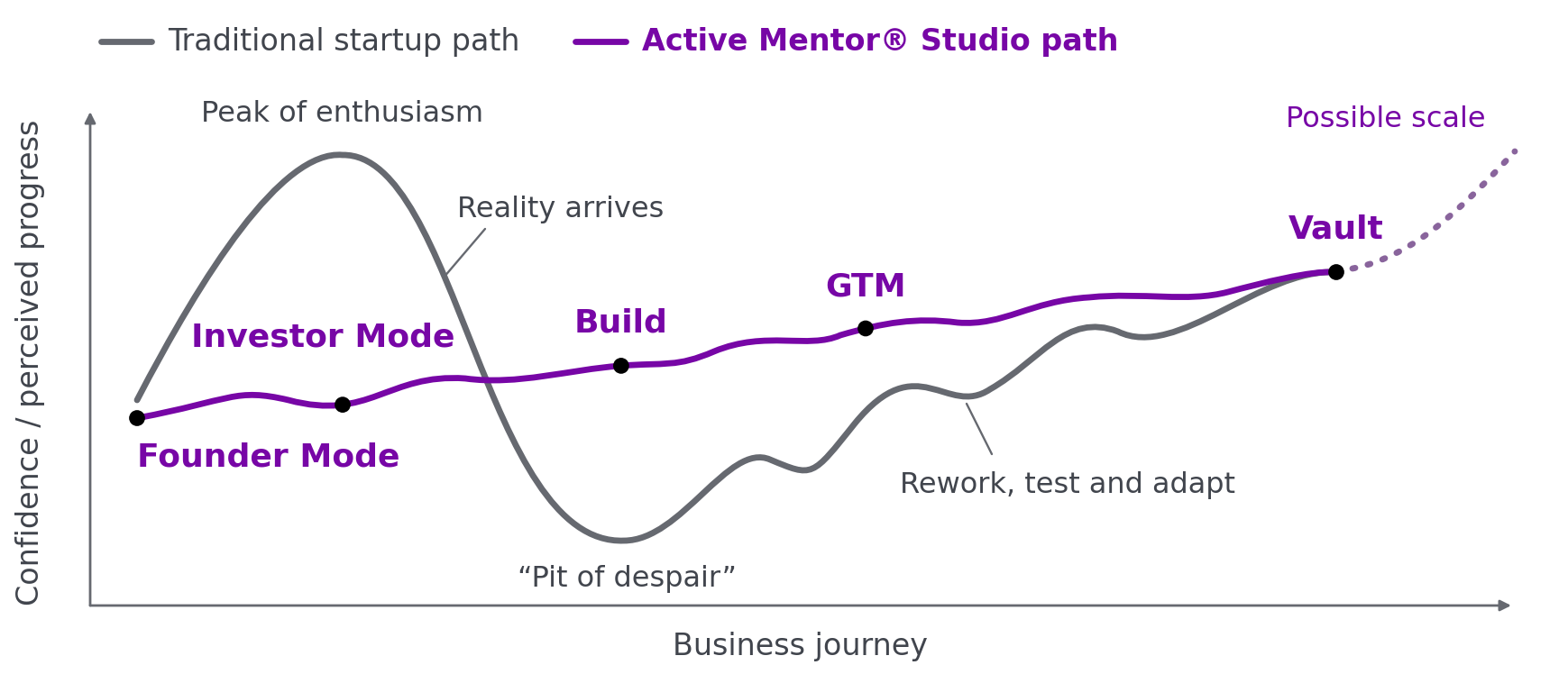
The illustration compares a familiar startup curve with the Active Mentor® Studio sequence. It is conceptual, not a forecast; businesses and their evidence develop differently.
Free
Start with the business as you understand it.
Founder Mode begins with ten questions.
You explain the opportunity, intended customers, offer, delivery, money, commitments already made and the things you know are still uncertain.
AMS examines that picture as one connected business.
You receive clear feedback on what is presently understood, what remains uncertain and important questions that may not yet have been recognised.
You do not need a finished product, business plan or existing revenue.
Founder Mode does not give you a generic startup checklist.
Its purpose is to establish a useful starting picture.
Start with Founder Mode
£99
Before you invest more, understand what you are investing in.
The first investor in most new businesses is the founder.
Your money matters, but so do your time, expertise, foregone opportunities and commitments.
Investor Mode examines the business more deeply through a focused conversation and relevant external research.
Customers. Existing alternatives. Pricing. Delivery. Suppliers. Resources. Costs. Market conditions. Dependencies.
The question is not whether anybody can predict that the business will succeed.
The question is whether there is a sufficiently credible route to commercial operation to justify a controlled Build commitment.
The result may support the proposed business, a smaller or simpler starting configuration, further clarification, or a decision not to make the next commitment yet.

£999 | up to eight weeks
Work out what the business needs. Then get it working.
Build starts from the commercial configuration that has already been examined.
AMS identifies what must exist for the business to complete its intended commercial cycle.
That becomes a controlled project.
A new business can accumulate a website, branding, software, subscriptions and marketing while still being unable to complete a commercial transaction properly.
Build focuses on the commercial cycle.
Can the intended customer reach the offer? Do they understand what they are buying? Can they order or make the appropriate commitment? Can payment work? Can the business fulfil the promise? Can delivery be completed as specified? Can the direct delivery cost be seen? Can the transaction margin be seen?
A controlled dry run can establish whether those arrangements work.
If a genuine transaction happens naturally, it is useful evidence.
Build establishes operability. It does not claim to establish demand.

£1,499 | up to eight weeks
Sell it. Deliver it. Examine what actually happens.
Once the business can complete its intended transaction and the stage is approved, Go To Market moves into live commercial activity.
The work follows the actual route your business needs.
That may involve customer outreach, publishing an offer, handling enquiries, providing quotations, following up, processing orders, delivering, invoicing and collecting payment.
The important information is what happens as a result.
Who was reached? Who bought? What did it cost to reach them? What did delivery cost? What remained from the selling price? When did the cash arrive? How much founder effort was involved? What caused customers not to buy? What needs changing?
One sale is useful evidence.
AMS then looks for further independent target-customer commitments under a materially consistent way of operating.
It is to see the business as it actually trades.

£1,999 | optional | by invitation
Put the evidence in a form professional capital can inspect.
For some businesses, successful commercial operation creates further options. The founder may want to continue from trading income. They may want to build a profitable owner-operated company. They may later want to borrow. They may eventually have a credible reason to consider professional investment. Those are later decisions.
Investor Vault exists where the business has accumulated enough operating and customer evidence, together with a credible mechanism through which additional resources could expand commercial output.
It brings the relevant commercial record together in a professional, source-linked form.
Customers and commercial commitments. Revenue. Pricing. Acquisition. Delivery. Direct costs and margins. Cash movement. Ownership. Material operating decisions. Dependencies. Changes over time. Remaining uncertainty.
Where a recognised valuation method can be used defensibly, the assumptions and sensitivity can be shown rather than hidden behind a single confident number.
Its purpose is to present the available evidence clearly and truthfully in the way professional investors or lenders need to examine it.
They make their own decisions.
AMS does not arrange investment, provide introductions or predict whether funding will be obtained.
And a founder does not need to be seeking finance for the operating evidence to have value.

Frequently asked questions
Questions about Active Mentor® Studio
What you do, what you receive, what it costs and how you stay in control.
Founder Mode and decisions
Do I need a finished product?
No. Founder Mode can begin with an idea, relevant expertise or an opportunity you can explain. The purpose is to understand the business picture as it currently exists.
Do I need existing customers?
No. Existing customer evidence is useful where it genuinely exists, but it is not required to begin Founder Mode.
Is this a business course?
No. AMS works on the commercial configuration of your particular business.
Stages, payments and outcomes
Does joining mean my business will progress through every stage?
No. Each stage has its own purpose and entry requirements. Payment and progression are separate.
Does Build prove people want the business?
No. Build establishes commercial operability. Go To Market examines live customer behaviour.
Does one sale prove the business works repeatedly?
No. One independent customer is evidence. Further customer behaviour is needed before repeatability can be supported.
Is Investor Vault a pitch deck?
No. Investor Vault is a source-linked professional record of the commercial evidence, operating history, economics, dependencies and remaining uncertainties. It is designed for scrutiny, not to turn incomplete evidence into a better story.
Will AMS find investors for me?
No. AMS does not provide investor introductions, brokerage or fundraising execution.
What if I simply want a good owner-operated business?
That is a legitimate commercial objective. A business does not have to be built for external investment. Profit, independence, sustainable owner income and future investment optionality are different possible outcomes. The immediate AMS concern is whether the business itself can operate commercially.
Build, suppliers and Bench
Will AMS build everything for me?
No. You take an active part and remain responsible for the business. AMS establishes requirements, sets out agreed work, checks submitted results and reviews the evidence. You may undertake suitable work yourself or commission others.
Can I use my own suppliers?
Yes. AMS is supplier-agnostic. Suitable work may be completed by you, existing resources, external providers or, where eligible and authorised, an AMS Bench founder.
Does AMS decide how my brand should look?
No. Your creative identity remains yours. AMS can establish objective commercial requirements, such as making an offer understandable or meeting a legal requirement, without taking ownership of your aesthetic.
Does AMS minimise the amount I have to spend?
AMS cannot promise a particular starting cost. It does help distinguish what the business requires now from work that is unnecessary, unsupported or can wait. You approve your own expenditure.