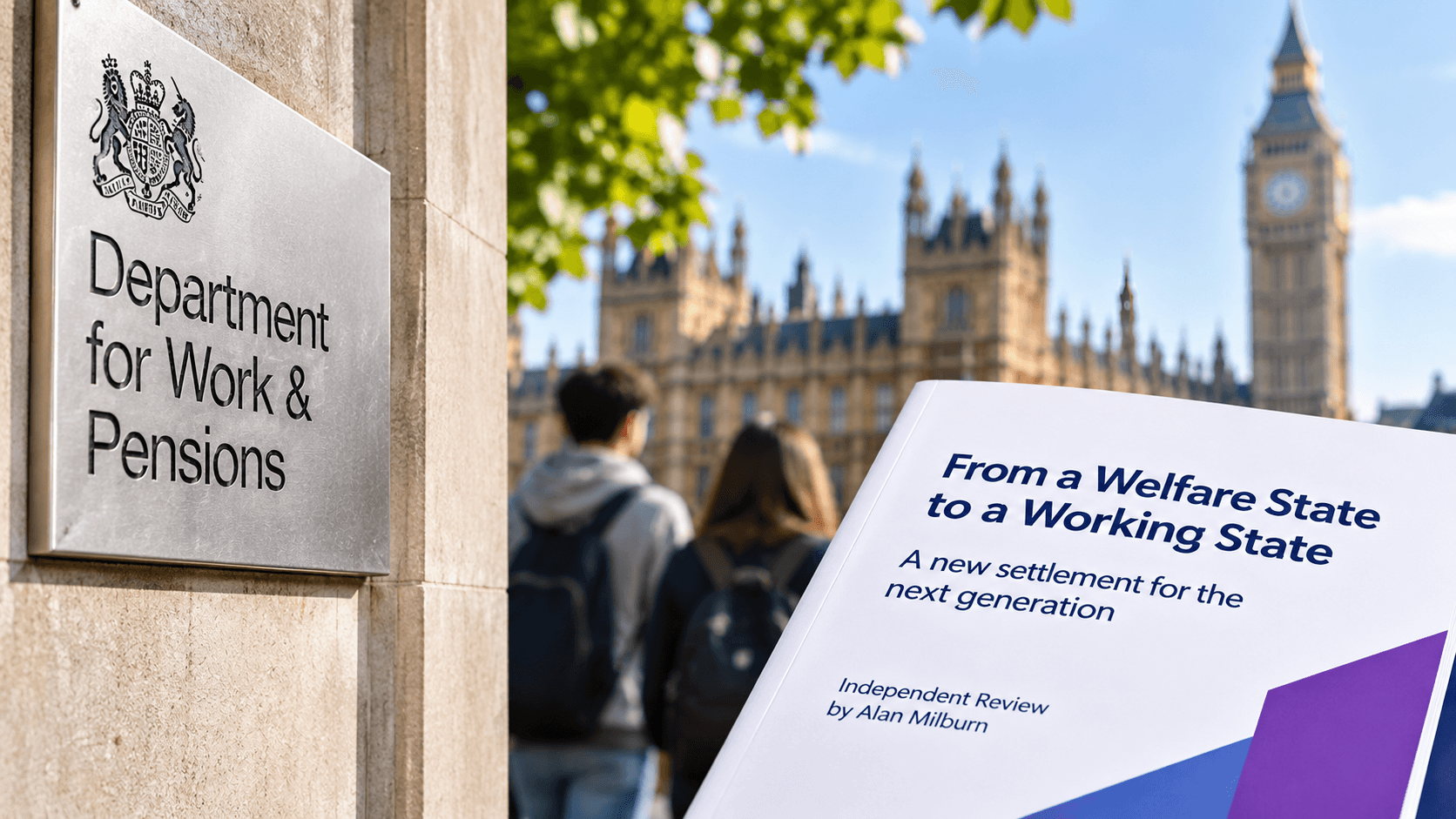
The Milburn review gives self-employment a place in its proposed settlement for young people. The challenge is turning that opportunity into a credible way to earn, rather than simply another invitation to start.
For a young person struggling to find suitable work, starting a business can look like a way to create an opportunity rather than wait for somebody else to provide one. They may have a useful skill, an understanding of a particular customer or an idea worth exploring. The question is not whether that ambition deserves encouragement. It is what would make the business capable of supporting the person behind it.
That is the enterprise question raised by Alan Milburn’s independent review, From a Welfare State to a Working State: a new settlement for the next generation, published on 17 November 2026. Its proposals bring together employment, education, health and welfare support, including a route into self-employment.[1]
The scale of the wider problem is substantial. The Office for National Statistics estimated that 981,000 people aged 16 to 24 were outside education, employment or training in April to June 2026, equivalent to 13% of that age group. This includes both unemployed people seeking work and economically inactive people. It is not a count of people who simply do not want a job. ONS also warns against overinterpreting short-term changes in these survey estimates.[2]
Enterprise deserves a place among the possible responses. But replacing “out of work” with “self-employed” would be an inadequate ambition if the person still lacked a dependable way to earn.
The useful part is the space to test before borrowing
The review proposes specialist enterprise support through a Youth Opportunity Service, up to £500 to explore a business idea before taking on loans, and access to a £3,000 grant following specialist assessment and validation of the proposition. It also asks government to consider a start-up period of up to 18 months under its proposed Youth Allowance, conditional on evidence of prospects and progress.[1]
These are recommendations in an independent review. Publication does not itself create an entitlement to the proposed support. The accompanying analytical annex explicitly distinguishes its analysis from agreed government policy.[3]
The most useful feature of the enterprise proposal is not necessarily the largest amount of money. It is the recognition that somebody should have room to learn before borrowing. A small amount spent answering an important commercial question can be more valuable than a larger amount spent implementing an assumption nobody has examined.
This should not become an argument against finance. Equipment, insurance, stock or the gap between delivery and payment may create a genuine cash requirement. The distinction is between money needed to put an understood arrangement into operation and money being used to discover whether there is a business at all.
The proposed support would be stronger if that distinction remained visible throughout delivery. A grant should enable a defined piece of commercial work, not become a reason to purchase a standard package of startup services regardless of what the particular business needs.
Entrepreneurial activity is not the same as an established income
GEM’s 2024 data put early-stage entrepreneurial activity among UK 18-to-29-year-olds at 15.9%. That measure includes people actively setting up a business and those running young businesses. It is not a measure of how many are earning a sustainable living. Its age range also differs from the 16-to-24 group in the headline NEET statistics, and it does not describe only people outside employment or education.[4]
That matters because it would be easy to put the two findings together and draw an unsupported conclusion: there are many young people outside work, young people are entrepreneurial, therefore business creation can absorb the problem.
The evidence does not establish that conclusion. An appetite for independence is different from a customer willing to pay. A promising idea is different from an arrangement that can deliver consistently. Neither distinction diminishes the person or the opportunity. It identifies the work that useful support should help them undertake.
Nor should the answer be to impose an ambitious growth story on every applicant. A modest operation that provides worthwhile earnings may be entirely appropriate. It should not need an investment pitch or a plan to employ dozens of people to be taken seriously. Equally, a business with impressive growth ambitions should not escape scrutiny of its immediate costs and customers.
The relevant question is what this particular venture could reasonably do for this particular person, and what evidence would justify their next step.
What should the first £500 help someone establish?
An initial exploration budget should buy learning that changes a decision. That might mean finding out who has the problem, how they currently deal with it, whether the proposed offer is attractive at a workable price, or what delivering it would actually involve.
Those questions belong together. A customer may want a service, but only with response times that the founder cannot reliably provide. A price may look attractive until travel, revisions, software and unpaid administration are included. A sale may be profitable on paper while requiring the founder to pay suppliers weeks before receiving the customer’s money.
Consider a fictional illustration, not a case study or a market benchmark. A young video editor expects four monthly customers paying £300 each. That would produce £1,200 in monthly sales. If software, outsourced work and travel cost £250, £950 remains before personal tax and provision for holidays, illness or retirement. The time spent finding customers, discussing briefs and managing revisions must also fit within the working week.
The useful early questions are now quite specific. What does the £300 include? How many revisions are affordable? Can the editor secure customers beyond the initial introductions? Will they pay in advance or after delivery? What happens to household cash if one payment is late?
A grant might help purchase equipment that genuinely reduces delivery time. It might fund a small, properly designed customer test. Or the exploration might show that the offer needs a different scope, price or customer group. Those are different findings, with different consequences. None is established by registering a business or completing a generic plan.
The objective should not be perfect certainty before action. Requiring a mature trading record before funding an initial experiment would defeat the point, particularly for someone without family money or an existing network. The evidence required should rise with the amount of money, time and responsibility being taken on.
Specialist assessment should therefore explain what is supported, what remains uncertain and why the proposed expenditure is reasonable. It should not be treated as a certificate that future customers will behave as expected. A first sale is valuable evidence. Whether further sales can be obtained and delivered on workable terms remains another question.
The founder’s household is part of the commercial picture
A business can have a plausible route to customers and still be impractical for its owner if they cannot survive the period before those customers pay. Assessing only the proposed company misses the person’s exposure.
Current Universal Credit guidance illustrates why this needs care. Eligible self-employed claimants can receive a start-up period of up to 12 months, during which actual monthly earnings are used and the minimum income floor does not apply. Outside that period, where the floor applies, support may be calculated using assumed earnings higher than the person actually receives. Eligibility and individual circumstances matter.[5]
Anyone considering self-employment needs a clear account of the rules that apply to them now, not an assumption that a newly published recommendation has already changed their position. Qualified benefits advice may be as consequential as advice about pricing or marketing.
Borrowing deserves the same clarity. A government-backed Start Up Loan is a personal loan, with personal responsibility for repayment. Government backing should not be mistaken for protection from the borrower’s own obligation.[6]
This is not a case for withholding opportunity from people with limited resources. It is a case for making the exposure understandable and providing support that addresses it. More time can help a business establish itself, but elapsed time alone does not show that it is improving. Reviews should examine what has changed in customer demand, delivery, costs and cash, rather than merely whether the founder remains enthusiastic.
A business also need not replace every form of public support to be worthwhile. Part-time earnings or an operation compatible with a person’s circumstances may be a valuable outcome. Disability-related support should not be confused with a temporary business grant, nor should its continuation be treated as evidence that the enterprise has failed.
The objective should be a better, sustainable position for the person, not simply the fastest possible exit from a benefits category.
Support can help, but the evidence needs the right interpretation
There is evidence against the idea that enterprise support is merely encouraging talk. The British Business Bank’s evaluation published in December 2024 found higher survival and stronger employment and asset growth among assessed Start Up Loans businesses than comparison businesses. It examined recipients from the 2018/19 and 2021/22 cohorts.[7]
That is a useful reason to take a defined package of finance and support seriously. It is not proof that every grant, mentoring scheme or youth enterprise offer will produce the same result. Those cohorts are not the same population as the young people addressed by this review, and business survival alone does not establish whether an owner earns enough for the hours and risk involved.
Earlier experience also shows why different types of evidence should remain distinct. A DWP evidence review published in October 2024 reported positive qualitative findings for the New Enterprise Allowance, but noted that an impact evaluation was not available at the time.[8]
That does not demonstrate that the programme failed. It means that accounts of useful support, numbers of businesses started and evidence that the intervention caused better outcomes answer different questions.
For a new youth enterprise pathway, we should ask what happened after the initial support and what would probably have happened without it. Following participants at six, twelve and twenty-four months could reveal much more than counting starts: customer income, business costs, money available to the owner, hours worked, debts, continued trading and subsequent moves into employment or education.
Those records should include people who do not start, change direction or leave the programme, not just those still available to describe a successful business. Otherwise the evaluation could tell a reassuring story about the survivors while missing the experience of everybody else.
There is also a wider economic question. Several new firms might win customers from existing local businesses rather than create additional demand. That possibility does not make the individual ventures illegitimate, but it matters when estimating the public benefit. Support that helps someone reach a different market may have a different effect from support that adds another supplier to an already crowded one.
The review’s own projections need the same discipline. Its analytical annex models a NEET rate of around 6.8% in 2036 from the wider package and says costs, impacts and deliverability require further departmental refinement and assurance. This is conditional modelling, not an observed outcome, and it does not establish what the enterprise proposals alone would achieve.[3]
Choice must remain real
A credible route into self-employment should sit alongside good employment, education, training and appropriate health support. It should not become the option offered because the other options have not materialised.
For someone whose condition or caring responsibilities make conventional employment difficult, the relevant question is not whether self-employment sounds flexible. It is whether the particular operating arrangement can accommodate their circumstances while meeting its obligations to customers. A flexible diary does not, on its own, resolve delivery deadlines or income uncertainty. Business advice cannot substitute for necessary healthcare or practical assistance.
The same commercial test applies on the employer side. Helping an existing small business take on a young person may be a better route in some circumstances than encouraging a new business to be created. But the employer still needs work that supports the role, cash to cover its costs and the capacity to supervise and train. An initial incentive cannot be assumed to resolve all three.
This suggests a useful discipline for those commissioning support: do not reward only the most easily counted event. A new registration, loan or placement is a beginning. A well-supported change of direction can also be valuable when it leaves somebody better able to earn without carrying avoidable debt. That is not a reason to celebrate every closure or delay. It is a reason to examine what happened and why.
An opportunity worth making practical
The enterprise proposal deserves attention because it can be developed into something more useful than encouragement to become a founder. It offers a basis for asking what support should actually do between the first idea and the first dependable income.
That work is practical. Understand the customer. Establish what can be delivered and on what terms. Make the costs and cash timing visible. Use proportionate tests before taking on larger obligations. Then learn from what paying customers actually do.
None of this guarantees that a business will work. It gives the founder and the people supporting them a clearer basis for deciding what to do next.
A working state should widen the routes through which young people can contribute and improve their circumstances. For some, that will mean building a business of their own. The worthwhile ambition is not merely to help them start one. It is to help them establish whether, and how, that business can provide a living.